The revelation on May Bartram’s birthday
The Beast in the JungleThe revelation on May Bartram’s birthday is a turning point in John Marcher’s vigil with May: her silence makes him suspect that she knows the truth about his future, but her warning that he will never find out leaves him without the understanding that might have changed his life. In retrospect, the moment marks both May’s recognition of his fate and the missed possibility of a life formed by mutual love.
Background: A Fate Imagined as an Event
Marcher has long treated his future as something waiting to break into his life: an encounter or shock that might destroy his consciousness, annihilate him, or alter everything and leave him to its consequences. The danger, as he describes it, is not a deed by which he might distinguish himself, but something he must suffer. May once suggests that this expectation could be the familiar danger of falling in love. Marcher does not accept that interpretation as an answer, and the idea of an impending, unspecified event continues to organize his attention.
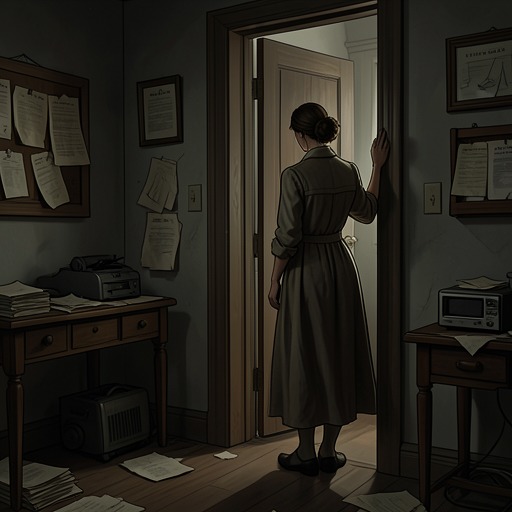
By the later conversation, however, the suspense has become an established part of their shared life. Marcher repeatedly brings the subject into the little drawing-room where they have met year after year. Its familiar objects and worn carpets register the accumulated passage of his nervous moods; the room is, in effect, a record of the years he has spent watching for his fate. Their intimacy has been sustained by this vigil, but it has also remained bound to Marcher’s preoccupation with himself.
The Conversation and Its Warning
May says that she is more certain than ever that her curiosity will be repaid. Marcher, newly alert to the possibility that she is holding something back, asks whether she has become afraid. He recalls that she had asked him the same question on their first day at Weatherend, when he could not say whether he was afraid. May acknowledges that there have been days when she thought he was, though, over the years, they have thought almost anything.
For Marcher, the exchange opens onto the whole barren history of their speculation. He senses that the imagined Beast has repeatedly shown itself in their thoughts, but that the many possibilities have dwindled into suspense alone. He now believes he is no longer afraid. May’s reply distinguishes mere endurance from resolution: she considers him accustomed to living close to danger, so accustomed that he has lost his sense of it, but insists that the watch is not over. He still has everything to see.
Marcher presses her. Her silence and expression persuade him that she knows what will happen and is afraid to tell him because the truth is terrible. The narration leaves open whether his inference is right, but makes the consequence of the exchange unmistakable: May tells him he will never find out. The warning becomes the scene’s sharpest reversal. Marcher takes it as evidence that knowledge is being withheld from him; he does not understand that the failure to know may already be bound up with the way he has lived.
Retrospective Meaning
The conversation’s immediate effect is not to resolve the mystery. It lightens the pressure of the subject for a time, and Marcher tries to correct his self-absorption by inviting May to the opera. Yet the hour remains a landmark: later exchanges return to it as recollections and consequences. Its importance lies less in an answer Marcher receives than in the answer he cannot read in May’s face.
At the cemetery, the meaning becomes clear to him too late. Marcher recognizes that May had seen the truth while he had not: the fate he feared was that nothing would happen to him, and the long wait was itself his portion. He understands that May had offered him an escape, not by disclosing some external catastrophe but through the possibility of loving her. She had loved him for himself; he had regarded her chiefly in terms of the use she served in his vigil. The revelation thus transforms the earlier warning into evidence of both her understanding and his blindness. May’s prediction that he would never find out proves tragically exact: he recognizes the love and the life he missed only after her death, when recognition can no longer alter either.